What Makes Orthodontic Care Convenient for Families

Families asking what makes orthodontist care convenient for families are often thinking about more than the trip to an appointment. School, work, activities, daily appliance care, and communication with the office all shape how treatment fits into ordinary life. The right plan depends on an orthodontist’s assessment, but it is reasonable to compare the practical details before deciding where to begin.
What does convenience mean in orthodontic care?
Convenience is the fit between a patient’s care plan and the routines that support it. A nearby office and workable appointment times matter. So do the time needed to travel, who can bring a child, what the patient needs to do at home, and how questions are handled between visits. Those details are worth understanding before treatment begins because orthodontic care is not a one-time appointment.
It also helps to separate logistics from clinical decisions. An office’s location and hours are practical considerations. The choice of appliance, the care plan, and the follow-up schedule are clinical matters an orthodontist evaluates for each person. A treatment option that sounds easier in the abstract may not suit a particular patient, and no device removes the need to follow professional instructions.
For some families, convenience means being able to plan around a school day. For others, it means knowing exactly what a teen must do with removable aligners or where to ask a question if something is unclear. Adults may weigh work commitments and travel differently. Start by identifying the real constraints in your household, then ask how the proposed plan fits them.
How can appointment timing fit family life?
Before choosing a practice, ask which appointment times are available and how often they are offered. Shullman Orthodontics publishes weekday hours and Saturday appointments from 9 a.m. to 1 p.m. twice monthly. Saturday availability can vary, so confirm the current dates and hours rather than assuming the office is open every weekend. Check current weekday hours as well when comparing them with school, work, and after-school activities.
Think through the calendar as a family, not just the appointment slot. A visit scheduled near the end of the school day may involve pickup, traffic, and a missed activity. An early appointment may work well for one parent but not for another caregiver. If a child has a recurring activity or an adult has limited flexibility at work, mention that when asking about scheduling. The office can explain which appointment times may be available for the care plan.
Compare current office hours with the times your family can reliably travel.
Ask whether Saturday appointments are available on dates that work for you, and how far ahead to plan.
Find out how to request a change if illness, school, or work disrupts an appointment.
Ask what notice the office requests when rescheduling and how to get in touch.
Allow for the trip and transition time, not only the time spent in the office.
Do not assume every appointment has the same purpose or can be arranged at any hour. The type and timing of visits depend on the patient’s individual care plan. During a consultation, ask which appointments are expected at the start, how the office communicates the schedule, and whom to contact if a conflict comes up. A clear answer helps a parent plan without relying on guesses about how often visits will be needed.
Why should families consider location and travel?
Location matters because the trip becomes part of the family’s routine. Consider the route at the time of day you would likely travel, parking, and whether the office is convenient from home, school, or work. If more than one adult may bring a child, think about whether the location works for each person. For teens, discuss in advance who will coordinate transportation and communication with the office.
Shullman Orthodontics has one office at 9859 Lake Worth Rd., Suite 21, Wellington, Florida. Families in nearby communities can weigh the drive to Wellington against their own schedules and transportation options. A community mentioned in service-area information does not mean the practice has another office there. It is useful to map the actual journey from the places your family travels each week rather than judging convenience by a city name alone.
Try a practical test: imagine the trip on a regular weekday, then consider what happens if the appointment is before school, after work, or during a busy activity season. A route that seems simple on a quiet weekend may feel different at peak travel times. Families who share transportation can also identify a backup driver. These small planning steps help make the office location part of an informed decision rather than a surprise after treatment starts.
How do treatment routines affect day-to-day convenience?
Appliances differ in how they fit into daily habits. Braces are attached to the teeth and are managed during office care. Clear aligners are removable, so the wearer has responsibility for following the orthodontist’s wearing and care instructions. Those differences may matter to a patient who plays sports, eats meals away from home, or prefers not to manage a removable appliance throughout the day. They do not establish which option is clinically appropriate.
Shullman Orthodontics offers conventional metal or clear braces and Invisalign for appropriate patients, including selected growing children who qualify for Invisalign First. Clear conventional brackets and clear aligners are distinct options. A consultation can help clarify which choices are relevant to an individual patient. Read about braces and available options or learn about Invisalign care before making a list of questions.
For an aligner wearer, the everyday routine can include remembering where the aligners are, following the prescribed wear instructions, and caring for them as directed. Parents may want to discuss how a child will manage that responsibility during school, meals, and activities. For braces, a patient can ask what routine care is expected and what to do if a concern arises. A teenager’s willingness and ability to follow instructions is part of the practical conversation, not a reason to choose an appliance without an examination.
Try comparing a normal weekday rather than imagining an ideal one. What will the patient do at lunch? Where can an aligner case be kept? Who will help a younger child remember the agreed routine? Will the family need to coordinate appointments around a sport or performance? These questions do not predict treatment outcomes. They make the discussion concrete so the orthodontist can explain the responsibilities associated with options under consideration.
Practical factor | Question to ask | Why it matters |
Appointment schedule | Which appointment times are available, including variable Saturdays? | Families can compare actual openings with school, work, and travel routines. |
Appliance routine | What daily tasks and instructions come with each suitable option? | The patient and caregivers can decide whether the routine is manageable. |
Between-visit contact | How should we contact the office with a question? | Knowing the process can reduce uncertainty when a concern arises. |
Financial planning | What is the fee for the proposed plan, and what payment arrangements are available? | Costs and arrangements should be discussed for the individual case. |
Can digital tools help families stay informed?
Digital tools can be part of the care experience, but they should be understood for what they do. Shullman Orthodontics prescribes app-based DentalMonitoring scans for appropriate patients. These scans can support communication between office appointments by giving the care team information to review remotely. The practice does not schedule app-based scans, and remote monitoring is not a replacement for in-person visits or a promise that a patient will need to come to the office less often.
Before relying on an app, ask how a patient receives instructions, what is expected when a scan is due, and how to get help if the process is confusing. Ask what to do if a scan cannot be completed or if the patient notices an issue that needs attention. The clinical team determines the appropriate follow-up, and patients should continue to attend visits in the care plan. The practice’s DentalMonitoring information describes this offering.
Digital communication can be useful when a parent wants to understand how updates are shared, but it is not a substitute for knowing the regular contact route. Ask whether a question belongs in the app, a phone call, or an office visit. It is also worth making sure that the patient and caregiver know who will check messages and help a child respond to instructions. A simple, shared process can prevent a family from assuming that someone else has seen an update.
What should families ask about fees and planning?
Practical planning includes understanding the financial commitment. Ask for the case-specific fee for the proposed treatment and what the fee includes. If more than one option is appropriate, ask how the financial details differ and what payment arrangements may be available. Do not treat a general estimate or an advertised offer as a quote for an individual case. The practice’s published information says most braces cases cost $4,000–$8,000, but that range does not apply to every service or replace a case-specific discussion.
Clear answers help families plan alongside other household commitments. Ask when payment is due, what payment methods or arrangements the practice offers, and whom to contact with a billing question. If a parent or guardian is coordinating care with another adult, agree on who will receive financial information and help make decisions. A consultation is an appropriate time to ask these questions; doing so does not commit a family to treatment.
What can families expect from an initial consultation?
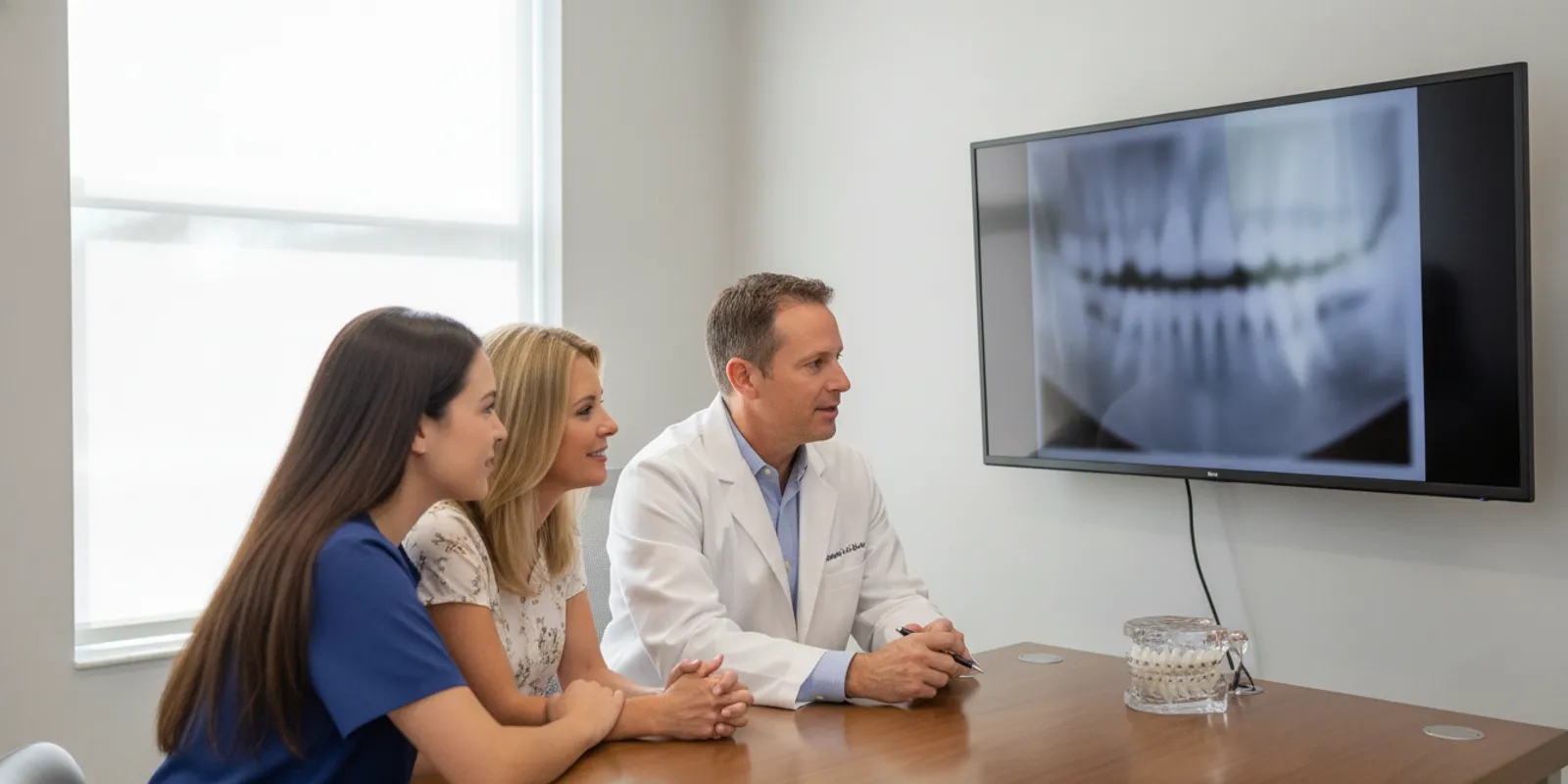
A complimentary consultation is an opportunity for evaluation and discussion of an individualized plan. It is not a promise that a patient needs treatment or qualifies for a particular appliance. For a child, an evaluation may lead to a recommendation to monitor growth rather than start treatment immediately. The American Association of Orthodontists recommends that children have an orthodontic checkup by age seven; that check is an evaluation, not an automatic instruction to begin treatment. See the American Association of Orthodontists for information about orthodontic care.
To make the conversation useful, bring the questions that matter most to your family. You may want to note school and work constraints, sports or other recurring activities, travel arrangements, and any questions about appliance routines. Ask what the orthodontist is evaluating, which options are relevant, and what the next step would be if treatment is recommended or if observation is more appropriate. Families can also review the practice’s complimentary consultation information before arranging a visit.
Which treatment options are appropriate for this patient, and why?
What daily responsibilities come with each option being considered?
How will appointment timing and follow-up be planned?
What is the best way to contact the office between appointments?
What is the case-specific fee, and which payment arrangements are available?
What records or information should we bring to the first visit?
How can parents make a plan that works for a child or teen?
Parents often coordinate transportation, calendar changes, and reminders, while a child or teen takes on more responsibility for daily care as appropriate. It helps to discuss that division before treatment starts. For example, a parent might manage appointment reminders while a teen keeps track of the aligner instructions explained by the orthodontist. The exact responsibilities depend on age, the appliance, and the plan. Agreeing on who does what can make the routine easier to follow without suggesting that one appliance is right for every young patient.
Children’s needs and schedules change as they grow. A first evaluation does not mean treatment must begin at once; the orthodontist may recommend observation or another course after assessing the individual child. Parents can ask what signs or timing would prompt another discussion and how the office will communicate the recommendation. This makes it easier to plan around school years and activities while keeping decisions grounded in a professional assessment.
Teens can take part in the conversation by describing which routines feel manageable and asking their own questions. If an aligner is being considered, discuss the responsibility of wearing it as instructed. If braces are being considered, ask about the usual daily care and how to seek help with a concern. A shared understanding helps parents support the plan while allowing the patient to participate in age-appropriate ways.
What should adults consider when comparing convenience?
Adults may need to coordinate care with work, travel, caregiving, or other commitments. Before a consultation, consider which appointment windows are realistic and how much notice is needed to adjust a workday. Ask how appointments are arranged and what the office recommends if a scheduling conflict arises. If discreet options are important to you, raise that preference and ask which treatments, if any, may be suitable after an examination.
It can also help to consider how an appliance would fit into meals, presentations, travel, or other regular activities. These are preference and routine questions, not a substitute for the orthodontist’s assessment. Write down the situations you want to discuss so the consultation can address practical fit alongside clinical considerations. Adults should also ask for the financial details of their own proposed plan rather than assuming that a published range for braces applies to other treatment.
Frequently asked questions
Are Saturday appointments available every week?
No. Saturday appointments are published as 9 a.m. to 1 p.m. twice monthly, and availability can vary. Confirm the current schedule with the office before planning around a Saturday visit.
Does DentalMonitoring mean fewer office visits?
No. App-based scans can support communication between office appointments for appropriate patients, but remote monitoring does not replace needed in-person visits or promise fewer visits. The orthodontist determines follow-up for the individual patient.
Is Invisalign automatically more convenient than braces?
No single option is automatically the most convenient for everyone. Aligners are removable and require the wearer to follow instructions; braces have a different daily routine. The orthodontist can explain which options are appropriate and what responsibilities each involves.
Does a complimentary consultation mean treatment will start?
No. The consultation is an evaluation and a chance to discuss a case-specific plan. Depending on the assessment, the recommendation may be treatment, observation, or another course.
When comparing orthodontic care, look at the full routine: travel, appointment timing, the patient’s daily responsibilities, communication, and financial planning. A conversation with the orthodontist can help your family understand how those details relate to an individualized plan.