Straight Teeth: What Treatment Can Address

Updated: 4d
Straight teeth are what most people picture when they think about braces. A smile can look uneven for several different reasons, and those reasons do not all need the same plan. Crowding, extra space, a rotated tooth, or a bite that does not meet evenly can each change how a smile looks and how it works. An orthodontic evaluation sorts those findings apart before anyone talks about an appliance.
At Shullman Orthodontics in Wellington, Dr. Howard Shullman, DMD, and Dr. Johnny Gonzalez, DMD, use that visit to explain what they see. A complimentary consultation is an evaluation and a case-specific plan. It is not a promise that every person needs braces, or that every child or adult qualifies for a particular aligner or bracket.
What Straight Teeth Actually Means
People use "straight teeth" for a smile that looks even from the front. Orthodontists look at more than that front view. They check how each tooth sits in the row, how the upper and lower teeth meet, and how the jaws relate when you bite down. A tooth can look fine in a photo and still sit too far forward, tip inward, or miss the tooth it should touch.
The American Association of Orthodontists describes this work as care for irregularities of the teeth and jaws. It is not a cosmetic polish on the front six teeth. Closing a small gap can be one goal. Guiding a bite so the back teeth meet more evenly is another. Both can be part of a plan for straight teeth, and starting treatment does not guarantee either one.
A general dentist and an orthodontist look at different parts of the same mouth. Your dentist watches decay, gums, and restorations. An orthodontist spends additional training on tooth position and jaw relationships. The two work together. If a tooth needs a filling, a crown, or gum care, that dental work may need to be timed around tooth movement. The orthodontist does not replace those visits.
Looks and Function Are Not the Same Goal
A parent may notice a crooked front tooth. An adult may notice that floss shreds in one spot. Those clues are useful, but they are not a diagnosis. Two smiles can look similar and need different plans because the bite behind the smile is different. That is why a photo of "straight teeth" is a weak way to choose an appliance.
What an Evaluation Looks For
The first visit is a conversation and an exam, not a commitment to start. The orthodontist looks at the teeth you can see and, when records are needed, at how the rest of the mouth is developing. Findings usually fall into a few groups.
- Crowding.
Teeth overlap, twist, or sit behind the row because there is not enough room in the arch.
- Spacing.
Gaps remain between teeth, including a space that never closed after a baby tooth was lost.
- Alignment.
A tooth is rotated, tipped, or sitting higher or lower than its neighbors.
- Bite relationship.
The upper and lower teeth meet too far forward, too far back, off to one side, or not at all in one area.
- Room for teeth still coming in.
In a growing child, the exam also asks whether adult teeth have a path into the arch.
Crowding and spacing are not opposites you can judge from a mirror alone. A smile can have a gap in front and crowding on the side. A bite can look even when the back teeth only meet on one side. The evaluation is where those combinations get named in plain language.
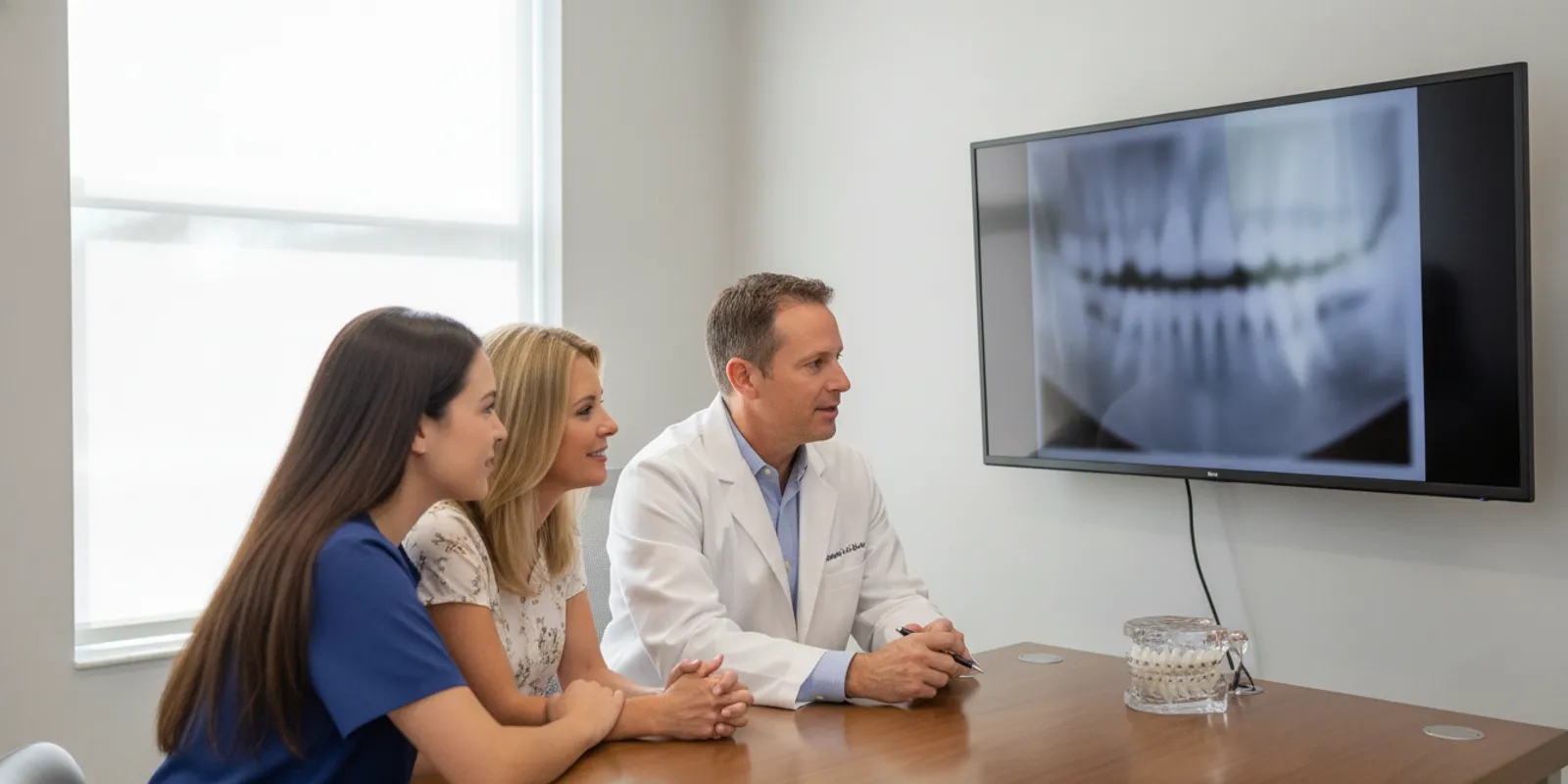
Shullman Orthodontics uses an iTero Element scanner when a digital model will help. The scanner captures a 3D picture of the teeth without a traditional putty impression. That model lets you and the doctor look at the same image while you talk about what is crowded, spaced, or out of line. A scan is a record. It does not by itself decide that treatment should start.
Crowding, Spacing, and Rotated Teeth
Crowding is the reason many families first ask about straight teeth. Overlapped front teeth are easy to see. Crowding farther back is easier to miss and harder to clean. Twisted teeth can hold plaque along the gumline even when someone brushes carefully. An evaluation measures whether the arch has room, not just whether the front looks uneven.
Spacing raises a different set of questions. A small gap may be a cosmetic preference. A larger space may come from a missing tooth, a smaller tooth, or a bite that keeps teeth from settling. The orthodontist should name which one is present before anyone talks about closing it. Moving teeth into a gap from a missing tooth is a question for your dentist too, not a simple aligner switch.
Rotated and tipped teeth sit in between. A single turned tooth can make a whole smile look uneven. It can also change how that tooth hits the tooth below it. Treatment, if it is recommended, aims to place the tooth so it looks even and meets the opposing tooth more evenly. The amount of movement, and whether braces or aligners are a fit, depends on the records from that person.
This article stays at that overview. Separate pages will go deeper on crowding, gaps, and specific bite patterns as those guides are published. The useful step now is knowing which finding you are actually asking about.
How Bite Position Changes the Plan
A bite is how the upper and lower teeth fit when you close. Straight front teeth can still sit in a bite that is too deep, too open, or shifted to one side. The American Association of Orthodontists notes that correcting a misaligned bite is a primary goal of orthodontic treatment because those relationships can interfere with eating and speaking. That is a reason to evaluate, not a promise that treatment will change chewing or speech for a given person.
What you might notice. | What the exam is checking. | Why it is separate from a straight smile. |
Front teeth overlap a lot when you bite. | How far the upper front teeth cover the lower ones. | The front can look even while the overlap is deep. |
Lower front teeth sit ahead of the uppers. | The front-to-back relationship of the jaws and front teeth. | Lining up each row does not change that relationship. |
One side hits before the other. | Whether the jaw shifts as the teeth come together. | A shift can wear teeth even when the smile looks centered. |
Upper teeth sit inside the lower teeth. | A crossbite in the front or in the back. | It may be one tooth or a wider arch problem. |
Front teeth do not touch. | An open space when the back teeth are together. | Closing that space is different from closing a side gap. |
Names like overbite, underbite, crossbite, and open bite are descriptions, not treatment orders. Two people can share a label and need different plans because jaw size, tooth size, and growth are different. If the exam finds one of these patterns, the doctor should explain it with your own photos or scan rather than a generic diagram alone.
Adults sometimes arrive after teeth have shifted since earlier braces. Relapse, wear, and dental work can all change how a bite meets. The evaluation still starts with records. It does not assume that a previous appliance is the right next step, or that new treatment will match an old timeline.
Braces and Aligners Are Tools, Not the Diagnosis
Once the findings are clear, the conversation turns to whether an appliance makes sense. Shullman Orthodontics offers Invisalign for teens and adults, and Invisalign First when a growing child qualifies. The practice also offers traditional metal or clear braces and custom braces. Clear conventional brackets are another fixed-brace option. Invisalign First is not a palate expander. Those are different tools for different findings.
Traditional braces stay on the teeth and can be metal or clear. Color ties are a style choice, not a treatment difference. braces are custom brackets planned from a digital model. Invisalign uses a series of removable trays. Taking trays out helps with meals and brushing, and the plan depends on wear time. None of these is "the one" for straight teeth. Fit depends on the movements in the records, age, and daily habits.
Some families also use DentalMonitoring during treatment. The app and scan box let the team review phone photos between visits. It does not replace office checks, and it is not a way to skip the evaluation. A same-day start is sometimes possible with traditional braces, because those brackets are not custom-ordered for a later visit. That option is conditional. Custom appliances are not made while you wait.
What the Consultation Does Not Decide for You
A free consultation should leave you with a clearer picture, not a script. You should hear which findings matter, which appliance is being considered, and what still depends on records or dental care. You should not leave with a guaranteed finish date or a promised number of visits. No brand moves teeth faster for every case.
If a page describes a treatment as faster or more comfortable, read that as a product description from the practice or maker. Ask how it applies to the plan in front of you.
Children, Teens, and Adults Are Not the Same Visit
The American Association of Orthodontists recommends a screening at age 7. By then, a mix of baby teeth and permanent teeth is usually in place. Some bite problems are easier to see than a parent expects. The AAO lists clues such as crossbites, crowding, extra space, extra or missing teeth, and habits that affect the jaws. Most children checked at that age do not start treatment. The visit is a check, not an automatic set of braces.
Shullman Orthodontics makes the same point on its why age 7 page and its Invisalign for kids page. Early treatment, sometimes called Phase 1, is considered when a developing problem may be harder to address later. Crowding, a narrow arch, a crossbite, or a large overbite or underbite can fall in that group. A child whose smile already looks straight may only be asked back for a growth check.
Teens are the group many parents already expect to treat. Permanent teeth are in or nearly in, and school schedules drive the questions. The evaluation still has to separate alignment from bite. A teen who wants straight teeth for photos may also have a one-sided bite that matters more for the plan than the front-tooth cosmetic concern.
Adults bring a different history. Restorations, gum health, missing teeth, and old retainers all change what "straight" can reasonably mean. Treatment can still be planned. It should be coordinated with the dentist who maintains the teeth, especially if a bridge, implant, or veneer is part of the longer picture. Orthodontic movement does not replace those restorations, and a veneer is not an orthodontic plan.
How to Read a Recommendation
A useful plan names the findings first and the appliance second. Use the visit to ask the questions below. The answers should be about your records, not about a typical patient.
Which teeth are crowded, spaced, rotated, or out of line?
How do the upper and lower teeth meet, and does the jaw shift when they meet?
Is treatment being recommended now, or is the next step a growth check or a dental visit?
If an appliance is suggested, why that one instead of the others offered here?
What still has to happen before anything is placed, including scans, photos, or dental care?
What would count as a satisfactory result for this case, and what is not being promised?
Price is part of the decision, and it is not one number. The practice site says most braces cases cost $4,000 to $8,000, with flexible payments and 0% financing available. That range is not a quote for every service, and it is not a price for a particular Invisalign case. A seasonal savings banner needs current terms before you count on it. Ask at the consultation what applies to the plan you were just shown.
Office visits are at 9859 Lake Worth Rd., Ste. 21, Wellington, FL 33467. The phone number is (561) 868-5050. Saturday hours, when offered, are limited and should be confirmed when you book. Families from Lake Worth, Royal Palm Beach, and nearby Palm Beach County towns are seen at this one office. There is not a second clinic in those cities.
Frequently Asked Questions
Do straight teeth always need braces?
No. An evaluation can find that the smile and bite are fine, that the next step is a growth check, or that a dentist should address a tooth before any orthodontic plan. Braces and aligners are options after that finding, not the default.
Can Invisalign give you straight teeth?
Invisalign can be planned for many teen and adult cases, and Invisalign First may be planned for a qualifying child. Whether aligners fit depends on the tooth movements and bite the records show. The consultation is where that is decided, not a general article.
What if only one tooth looks crooked?
One rotated or crowded tooth is still worth an exam, because the bite around it may be involved. Treatment, if recommended, is planned for the way the teeth meet, not only for the tooth that shows in photos.
At what age should a child be checked?
The American Association of Orthodontists recommends a screening at age 7. That visit looks for developing bite and space problems. It does not mean a 7-year-old will start braces.
Will treatment make teeth perfectly straight?
No plan should promise a perfect or identical result. The goal is a specific set of tooth positions and bite contacts for that person. Retainers, dental work, and habits after treatment all affect how the result holds.
If you are trying to tell crowding from a bite problem, bring that question to a visit. Dr. Shullman or Dr. Gonzalez can walk through what the exam shows and whether braces, Invisalign, or another option is even the right conversation.